
Oct 19, 2026 · 7 min read· Summarize in ChatGPT
Choosing between veneer, solid wood, and engineered substrates involves more than style. Installation conditions differ from project to project, and those differences should guide the material recommendation.
Veneer vs. Solid Wood: When Veneer Is the Right Call
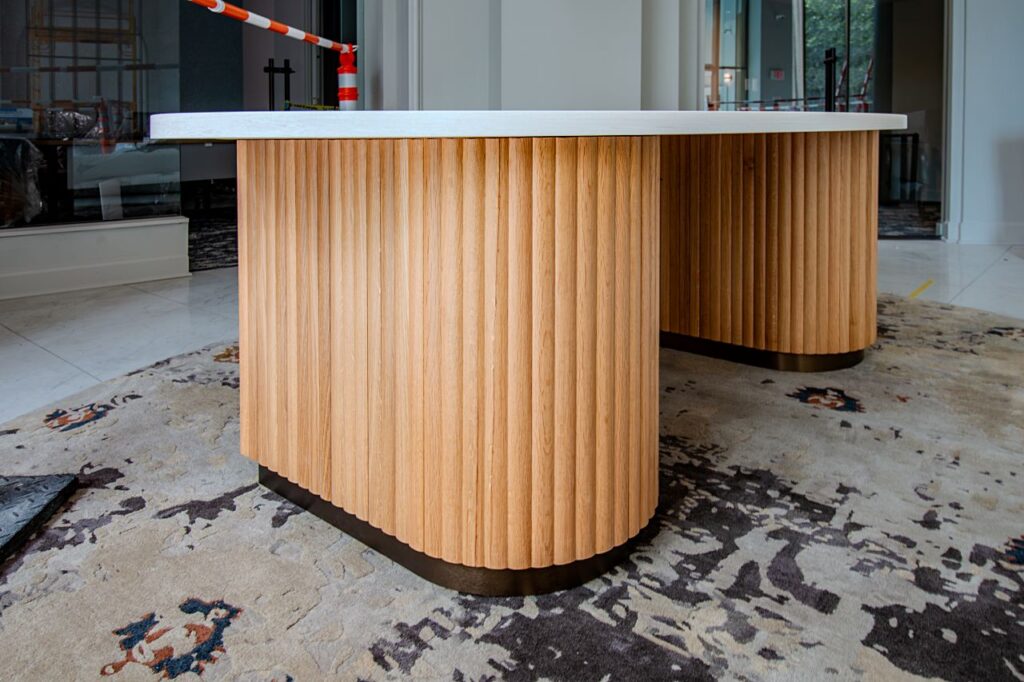
Wide-span millwork reveals one of solid lumber’s fundamental limitations. Across large, fixed surfaces, solid wood often struggles to hold its shape in a way that a veneer face bonded to an engineered core typically does not. The full visual character of the species, including figure, color shift, and grain movement, comes through in the surface, while fabricators rely on the engineered core to manage the structural and environmental load that solid wood alone would otherwise fight.
Consider a lobby wall panel running 12 feet across. At that width and span, seasonal humidity cycles take a toll on solid wood. Joints open and close, and faces develop crown or cup over time. When placed over a stable core, a veneer panel is more likely to stay put.
Grain matching is where veneer often has the advantage in large architectural applications compared to solid lumber construction. When our artisans cut and sequence leaves from the same flitch, they align the figure across panel joints without interruption. This goes beyond aesthetics. Fabricators can rarely achieve the same result with solid plank construction at scale, and for clients with a clear vision for how their space should read, the grain match is often the specification decision, not the budget.
When Solid Wood Is Worth the Cost and the Movement
At profiles, edges, and three-dimensional detail work, solid lumber may produce results that composite substrates with veneer faces cannot. Moldings with significant relief and thick built-up profiles that have to read as solid throughout their section require solid construction from the start. Applied veneer under those conditions can produce a visible seam at edge transitions.
Hand-applied penetrating finishes are the other driver. Fabricators see different results with certain oil and wax finishes on solid lumber compared to a veneer face over composite. Penetration depth, color development, and finish wear are all substrate-dependent in ways a specification sheet does not capture. For clients specifying that finish category on cabinetry, shelving, or built-ins, the material and finish decisions have to happen together.
Wood movement is the cost of solid construction. As the surrounding environment fluctuates, lumber absorbs and releases moisture, producing dimensional shifts across the grain. Managing that movement is not optional in solid wood construction. Panel float, slotted fastener points, and joinery that gives the wood room to shift seasonally without pulling against the surrounding assembly are all design requirements, not upgrades.
A fabricator who specifies solid wood without engineering for movement is delivering a piece likely to show its features within the first full seasonal cycle. Solid wood makes sense in the specification when the profile, edge, or finish behavior separates the designer’s intent from a serviceable alternative.
Millwork Material Selection: Comparing Engineered Wood and Solid Wood
Medium-density fiberboard (MDF), plywood, and high-density composite panels each address a different application, and no single option substitutes cleanly for the others.
MDF starts as a blend of wood fiber and resin pressed into a panel with a consistent surface at both the edge and the face. Because no grain runs in any particular direction, a router bit meets even resistance, and there is no telegraphing through the paint film. Fabricators can rout and edge MDF cleanly, and it accepts paint without substrate texture bleeding through to the surface layer. For painted cabinetry, door frames, and wall paneling where surface uniformity is the goal, MDF is often the technically sound choice.
In the comparison between solid wood, plywood, and MDF, plywood offers load and fastener retention properties that fiberboard lacks. Its cross-laminated structure distributes stress across layers and holds up under periodic moisture exposure, conditions where MDF often degrades at the core. Cabinet boxes, shelving structures, and millwork that carry weight or face humidity variation typically call for plywood as the substrate.
Phenolic-core and high-density composite panels meet requirements that exceed what wood-based panels can typically handle, particularly in environments with daily chemical contact or strict cleanability standards. Healthcare facilities and commercial food preparation spaces are the primary applications. Selecting between engineered and solid materials comes down to the application, not a quality ranking.
The Variables That Drive the Decision
Span is the first variable to establish, since solid lumber across an unsupported distance tends to move with the seasonal moisture cycle, while veneer over a stable core generally does not.
Moisture exposure also plays a significant role in determining the right substrate, since a bar top or any millwork installed near water equipment or high-humidity kitchen conditions typically needs different substrate logic than interior office casework. As moisture reaches the core, MDF tends to lose its structural properties, while exterior-grade plywood generally holds up. That distinction should be settled before dimensioning begins.
Finish type and substrate should be decided together, not in isolation. A high-sheen topcoat tends to reveal any texture or irregularity in the panel beneath it. A penetrating oil finish on a veneer face produces a different result than the same product on solid lumber. Locking in the finish specification before confirming the substrate often leads to a result neither the designer nor the fabricator intended.
Composite panel projects with indoor air quality or green building certification targets introduce an additional layer of complexity. The Toxic Substances Control Act (TSCA) Title VI program sets formaldehyde emission ceilings for composite wood products in the United States. Projects carrying Forest Stewardship Council (FSC) requirements or Leadership in Energy and Environmental Design (LEED) credits add chain-of-custody documentation to the sourcing requirement. A fabricator in those categories needs to specify and document no-added-formaldehyde (NAF) or ultra-low-emitting formaldehyde (ULEF) panels from the outset, not at closeout.
Reading a Fabricator’s Material Recommendation
Every material recommendation should connect directly to the conditions of the application. A veneer specification on a painted reception desk does not hold up in practice. A quality painted finish looks the same over MDF as it does over a veneer face, so specifying veneer only adds fabrication cost with no change in the delivered result. A solid wood recommendation for a large paneled wall requires a specific justification tied to profile, edge condition, or finish system.
Before signing off, ask what the moisture conditions are for the installation location and what finish system is being specified. Ask whether the span is appropriate for solid lumber given seasonal movement expectations, and what emission documentation is available for any composite panels. When a fabricator answers with specifics tied to the actual jobsite, that is a good sign they have engaged with the project. Vague, general answers suggest otherwise.
Start the Material Conversation Before the Spec Is Locked
A material specification change that surfaces during active fabrication is rarely a simple adjustment. Revised panel dimensions, new procurement lead times, redrawn shop drawings, and schedule compression can all follow from a substrate swap that a conversation at the design stage could have resolved.
Contact Sixth Avenue while the material specification is still open. We will work through the application requirements with your design team before the drawings go out for bid.
