
Mar 9, 2026 · 5 min read· Summarize in ChatGPT
 Historic buildings are changed over decades and centuries of use, retaining some elements while altering others. For owners and restorers of heritage buildings, renovations pose challenges not found in modern buildings. With the help of an experienced team of commercial millwork contractors and artisans, you don’t have to sacrifice the charm of a historic property to achieve modern functionality. However, the renovation process gains extra wrinkles that designers may struggle to overcome.
Historic molding profiles and styles should be preserved to maintain the original period’s charm and the property’s appeal. Still, modern building codes and design goals often get in the way of preservation. Respectful updates require precise replication, period-specific architectural knowledge, and experience with heritage properties. The right millwork designs paired with the right artisans can match historic details while cleaning up and improving existing trim.
Covered in This Blog:
Learn about the benefits of new millwork in restoring historic trim, matching its aesthetic details, and updating the functionality of heritage buildings. Millwork artisans combine time-honored techniques with new insight to replicate old standards while accomplishing new design goals.
What Is Historic Trim?
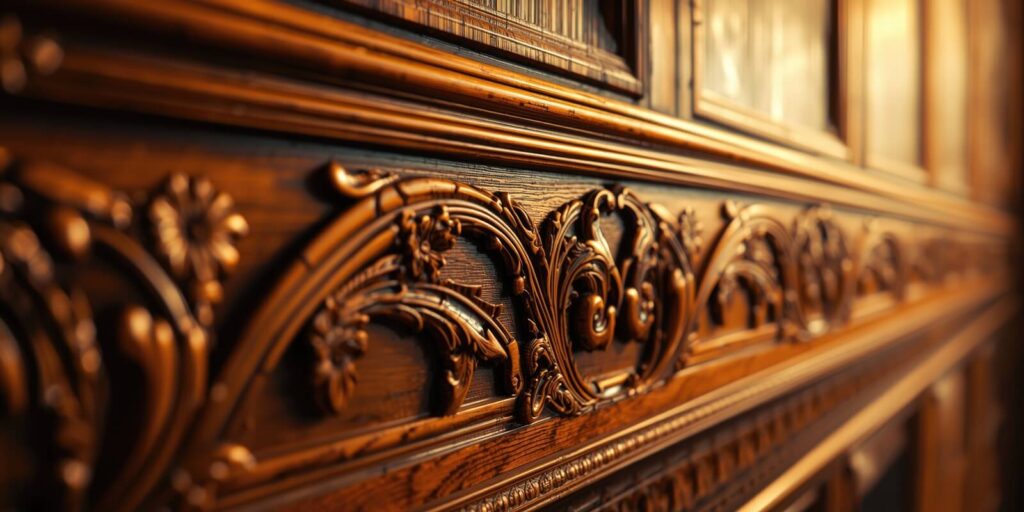
Historic trim is original millwork, including molding, backband, window stools, door frames, baseboards, and casings, which have outlasted the building’s other renovations and remodels. In many cases, historic trim is too damaged to be worth matching and repairing, so designers will replace it with something that matches the time period. This may be required if the damage is caused by an infestation or warping due to water damage.
However, in other cases, owners and architects may want to repair or add more trim to match the original. For more decorative periods, details can be intricate and specific, requiring sophisticated tools and methods to create believable matches. Even designs that are minimalistic on the surface can be surprisingly difficult to copy, down to the specific curves of a baseboard or the distinct angles of a window stool. No matter how detailed or simple, these fixtures add significant charm to a heritage building by preserving its core appeal. Hence, it benefits designers and architects to match them as closely as possible.
Essential Takeaway: Historic trim provides a window into the home or business’s design period and a gauge of its age. Though simple on the surface, these fixtures require significant attention to detail and craftsmanship to match accurately during remodels and renovations.
How Millwork Artisans Recreate Stylistic Periods Using Trim
Exact profiling and reproduction of millwork trim may not always be possible. Still, artisans use multiple techniques to get as close as possible to historic styles, even in minor repairs of damaged trim sections. Professional designers and heritage property owners know that even slight inaccuracies can create noticeable issues that are difficult to repair. Slight differences in style, make, or material can lead to a loss of immersion and value, taking the guest out of the experience rather than drawing them in.
Skilled commercial millwork contractors follow these two core steps to make sure their renovations and remodels match the stylistic period accurately when working on heritage buildings:
Accurately Assess the Style and Limitations of the Space
Every heritage building has a profile, shaped not only by its historic period but also by its limitations. Many buildings exhibit significant signs of water, pest, and natural aging damage. This damage may extend to other parts of the space, highlighting the need for experienced artisans to examine the space in its entirety and plan renovations that align with the owner’s budget.
Pro Tip: Buying trim in bulk can help a project run smoothly. Often, ordering a custom amount of trim or baseboard by the foot is more expensive than ordering enough for the whole space.
Sample the Original Millwork With an Eye for Detail
 A clean sample is a significant step in matching the style, material, finish, grain, and texture of the heritage millwork. A sample should be at least a foot long in the case of molding, trim, casing, baseboards, and other common millwork features, so that the artisans have a complete reference of the material’s original condition. They need dimensions as accurate as possible, including matching the width to the millimeter, so the replaced sections blend seamlessly with the existing ones.
Pro Tip: Old millwork is often painted, filled, sanded, finished, or a combination of these processes, often from old renovations. Any of these processes can change the width of the millwork to a degree that will make the final result uneven without careful measurement and consideration. Artisans use digital calipers and other tools to measure precise width and thickness with perfect accuracy to make sure the old and new trim flow seamlessly.
Partner With Experienced Artisans for Professional Results
At Sixth Avenue Custom, our team of millwork artisans recognizes the difficulties of renovating or remodeling heritage buildings. Historic molding profiles can be ornate, complex, and, above all, distinct, which is why residential and commercial millwork contractors experienced with the architecture and millwork techniques of their regions can be the best resource for anyone planning a heritage remodel.
Contact our team to schedule an on-site assessment and learn how we can replicate your building’s heritage style while adding modern functionality, without sacrificing the charm and value of your property.
