
Nov 9, 2026 · 5 min read· Summarize in ChatGPT
Millwork is wood, laminate, or a solid-surface material that has been fabricated in a shop and then installed as a finished part of a building. On a commercial bid, the word covers trim, paneling, doors, and sometimes the built-in cabinetry.
The Architectural Woodwork Institute’s quality certification program (AWI QCP) describes millwork as woodwork fabricated in a mill, which is why a single term can stretch across a baseboard, a paneled lobby wall, and a host stand.
What Millwork Includes
AWI QCP’s guide to the standards separates interior woodwork into sections, and each section matches a type of millwork a bid can price on its own line. AWI’s umbrella term for this category is interior architectural woodwork, and its standards cover specification, materials, fabrication, finishing, and installation.
Moldings and trim fall under ANSI/AWI 0622.0646-2024, which also covers shop-fabricated assemblies. Baseboard, crown, casing, and chair rail all belong here.
Wall and ceiling paneling has its own standard, ANSI/AWI 0642, which addresses solid wood, veneered, laminate, and solid surface panels. Stairs, handrails, and guards fall under ANSI/AWI SMA 0643 because a staircase combines many surfaces with heavy daily impact.
Casework, meaning built-in cabinets and storage, falls under ANSI/AWI 0641 for architectural wood casework and ANSI/AWI 1235 for project-specific casework in settings such as banks, schools, laboratories, and medical facilities. Countertops adhere to ANSI/AWI 1236, a standard that outlines specifications for dimensions, weight tolerances, and maximum deflection, as well as guidelines for assembly, edges, and joints.
Standing trim has a fixed shape and length, such as door casing, while running trim continues along a wall, such as baseboard or crown.
Casework vs. Millwork in a Spec
Casework literally means box making, according to AWI QCP, and refers to built-in cabinets, bookcases, and similar storage. That same article states that casework is technically a type of millwork, though it also sorts the two partly by how custom each one is.
The standards sort them by what the piece is, which is why architectural casework (ANSI/AWI 0641) and millwork and trim (ANSI/AWI 0622.0646) each carry their own standard. Casework is millwork in the broad sense and a separate scope in the narrow one.
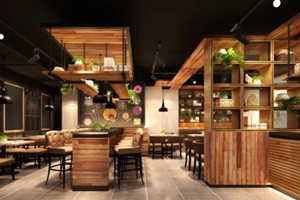
In restaurants, boutique fitness studios, and medical offices, the casework line can mean back bars, reception desks, and storage walls. A bid with separate lines for millwork and casework is typically pricing trim, paneling, and doors in one and cabinets in the other. A bid with only a millwork line leaves the cabinets in question, and you should settle that gap in writing before anyone signs.
Cabinetry sits inside casework, since ANSI/AWI 0641 covers base, wall, and tall cabinets along with their doors, drawers, shelves, and hardware.
Where Finish Carpentry Fits in the Process
Finish carpentry refers to the installation aspect of the trade, and ANSI/AWI 0620 addresses the installation of casework, wall and ceiling surfaces, standing and running trim, countertops, and passage doors. Pieces leave the shop as millwork and casework, and finish carpenters set, scribe, and fasten them in the building.
Grades Change What a Line Item Buys
AWI defines three aesthetic grades: Premium applies the highest degree of control over materials, workmanship, and installation; Custom a high degree; and Economy the minimum.
The finish carpentry standard converts those labels into measurements. Wood-to-wood gaps at field joints may not exceed 0.4 mm in Premium, 0.8 mm in Custom, and 1.2 mm in Economy. Premium and Custom call for coped inside corners on shaped trim, while Economy permits mitered or butted corners. Joints in a run of trim must sit at least 48 inches from the next joint in Premium and 36 inches in Custom.
For example, a joint held to 0.4 mm may take more shop and field time than one held to 1.2 mm. Thus, two bids that never name a grade may not be comparable line by line.
Submittals and Inspection
AWI 100 sets out the submittals that precede fabrication, including shop drawings, material data, samples, and approval. A project certified through the AWI Quality Certification Program receives visits from trained inspectors who confirm that the woodwork meets AWI standards and the project specifications while the work is underway. AWI 200 adds environmental requirements for storage, delivery, handling, and acclimation, so a buildout schedule that squeezes acclimation time works against the spec.
Questions to Settle Before Signing
- Which AWI grade is each line priced to, and does the spec name it? A line with no grade can be read as Economy by one bidder and Premium by another.
- Which AWI standard governs each line? Millwork and trim, casework, and installation each point to a different one.
- Who handles installation, and when does the wood arrive? Finish carpentry and acclimation both belong on the schedule.
Let Sixth Avenue Custom Build What the Spec Describes
Sixth Avenue Custom’s artisans build commercial casework and architectural millwork for restaurants, bars, offices, and homes across the DMV and beyond. The team collaborates directly with architects, interior designers, general contractors, and owners from a rough sketch or a full set of drawings through installation, with white-glove service. Call (301) 327-1504 or tell us about your project online, and we will walk through the scope line by line with you.
