
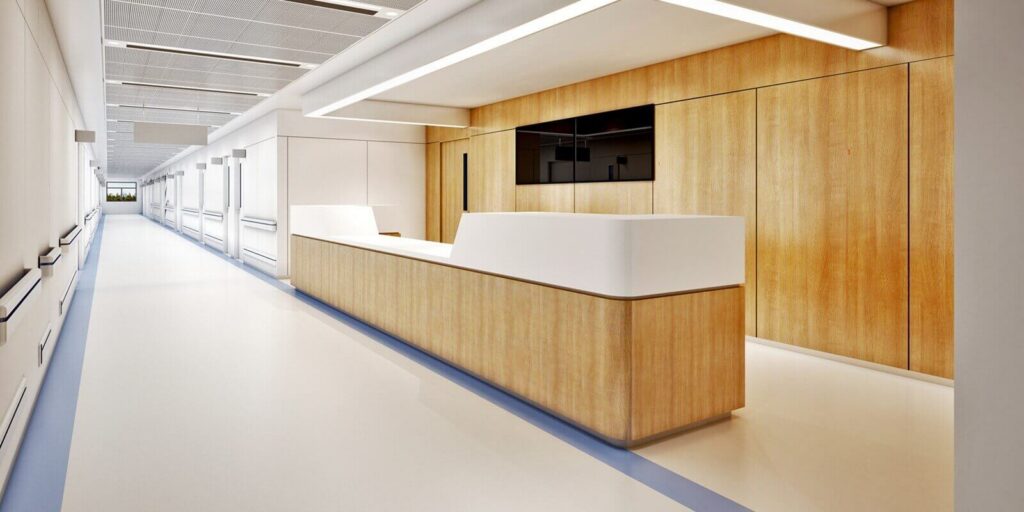
Oct 6, 2026 · 7 min read· Summarize in ChatGPT
We have watched casework that sailed through an office build-out start failing within the first year of clinical use. The breakdown rarely happens all at once. Laminate separates after a few months, or moisture works through a cabinet back before anyone notices the substrate is compromised. Neither failure gets caught until it is expensive, and both trace back to a healthcare millwork specification written for the wrong environment.
Why Healthcare Millwork Requires a Different Specification
Clinical environments put a chemical load on casework that standard commercial materials were never built to resist. Procedure rooms, sterilization areas, and nurse stations get disinfected with compound classes, quaternary ammonium and oxidizing agents among them, that attack laminate resin and soften adhesive bonds with every application. A surface built for a weekly office cleaning schedule can show seam separation and edge lifting within a year of that routine.
Moisture adds a second failure mode. Scrub sinks, utility fixtures, and sterilization equipment keep humidity at the floor and counter levels well above what a particleboard-core substrate is built to handle. That moisture does not sit politely on the surface. It works into cut edges and travels inward, and by the time it shows, the damage underneath is already serious.
Infection control adds a regulatory layer on top of both. We build to a cleanable standard in the clinical sense: no pores for pathogens to persist in, hardware a disinfectant wipe covers in one pass, and joinery that leaves no gaps for contamination to build up between cleanings.
Surface Materials for Medical Office Casework
We start material selection with chemical resistance, not finish or color. High-pressure laminate formulated for clinical environments uses a higher-density resin system than standard decorative laminate, which is why it holds up under repeated disinfection. Standard laminate, by contrast, degrades at the edges and around cutouts.
Solid surface solves this differently. Because it is fabricated with integral coved transitions at backsplashes and continuous pours at sink cutouts, it eliminates whole categories of seams before they become inspection problems. When a surface needs to be genuinely repairable, solid surface lets us refinish a damaged section in place instead of replacing it. For the broadest resistance across disinfectant chemistries, we turn to phenolic resin panels.
Substrate choice determines how long a surface performs. Particleboard cores absorb moisture through any breach in the surface layer, and that absorption speeds up at cut edges, where the material is most exposed. That is why healthcare-grade casework moves toward moisture-resistant or exterior-grade plywood cores, and sometimes phenolic-core panels, built to last across a facility’s operational life, not just through the warranty period.
Edge banding and seam treatment are where we see standard casework fail most often in healthcare settings. A raw edge at a sink cutout and a caulked joint between countertop sections both leave spots cleaning cannot reach. The fix is fabrication-level joinery, not a better caulk product.
The Codes and Standards Behind Healthcare Casework Requirements
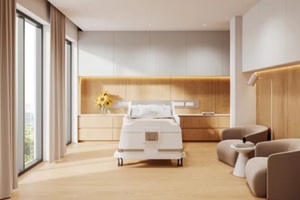
Most state licensing bodies evaluate clinical spaces against the framework set by the Facility Guidelines Institute (FGI) Guidelines for Design and Construction of Health Care Facilities. Under that framework, casework gets addressed through the lens of infection control: surface characteristics that permit complete cleaning, fixture configurations that avoid contamination reservoirs, and joinery without the horizontal details that collect debris between cleanings.
ADA requirements interact with clinical workflow in ways that have to get worked out before fabrication. A check-in counter built to accessible reach range requirements can conflict with the workflow height clinical staff need at a nurse station, and knee clearance has to be confirmed in the drawings, not caught at installation when the casework is already built.
Jurisdiction adds another layer on top of the FGI baseline, and none of it is uniform. Surface material approvals, fixture configurations, and cleanability criteria can differ between states, and even between facility types in the same state. If a requirement surfaces after fabrication, it becomes a modification order, and that work on installed clinical casework is neither cheap nor fast.
We have built through these regulatory layers on healthcare and medical office projects, where the standards shaped material and joinery decisions before the first shop drawing was produced.
Where Medical Millwork vs Commercial Casework Separates at the Failure Point
Of all the failures we see, laminate failure at sink cutouts happens most often. Standard laminate fabrication uses adhesive systems never rated for the moisture a clinical sink produces, and the bond at the cutout edge is usually the first place that shows, often within the first year of use.
Hardware durability runs on a different clock in healthcare settings, too. Standard hinges and drawer slides are cycle-rated for a typical office or retail environment, but a supply room cabinet in an active clinic can rack up in a week the open-and-close counts a commercial equivalent sees in a month.
The hardware wears on the clinical timeline, not the commercial one. Bacterial buildup at seams and joints will not show as visible damage, but it shows up in infection control reviews. Our answer is removing the joint entirely, through integral coved construction and continuous solid surface work, rather than treating it as a cleaning problem to manage later.
What Healthcare Grade Casework Costs and Why
The premium for healthcare-grade materials is a procurement reality, not a margin question. Chemical-resistant laminate, solid surface, and phenolic resin panels sit at different price points than standard commercial materials, and moisture-resistant plywood costs more than particleboard. Each decision reflects a different performance requirement, and the total cost follows from that.
Fabrication carries its own premium, too. Coved integral sink cutouts and continuous solid surface pours take time, and they demand joinery discipline that standard casework does not. If a seam falls short of clinical cleanability standards, it usually cannot be corrected in the field the way a cosmetic issue can on a commercial fit-out. We make sure the work is right before it leaves our fabrication facility.
Occupied or partially occupied healthcare facilities add coordination and protection requirements an empty commercial fit-out never faces. Sequencing around active clinical operations, protecting installed work from contamination, and managing phased occupancy access all add cost.
Replacing casework that fails a survey finding, or wears out early, costs more than the price difference between standard and healthcare-grade work would have. We build commercial millwork across law offices, restaurants, and retail spaces every week, and that range is exactly why we can point to where the healthcare premium actually goes, instead of just quoting a bigger number.
When a client has a clear picture of how their clinical space needs to function and feel every day, that is where our artisans earn their keep, building something that holds up for the life of the facility.
Start the Casework Conversation Before the Bid Package Goes Out
We would rather walk through a specification with an architect or project manager before the bid package is assembled than after a survey flags a surface that cannot be cleaned. Send us the floor plans and clinical program, and we will work through what the specification needs to hold up in that facility. Contact Sixth Avenue to start that conversation.
